We plug it in, turn it on, and forget about it. This is often how we interact with everyday electrical products. Yet, behind every outlet, every extension cord, and every appliance lies a question that deserves attention: does this product meet current safety standards? In Quebec, the answer isn’t found in the price or the appearance of the product. It is found in a small seal of approval.
A requirement, not an option
In Quebec, the sale of electrical products is governed by a clear rule: all electrical products placed on the market must be approved or certified by an accredited body. This is not a recommendation or a best practice—it is a requirement. This obligation exists for a simple reason: a non-compliant electrical product can cause short circuits, fires, electrocutions, or other serious accidents. Certification is the first line of defense between a safe home and an invisible risk.
Where to look for the seal of approval?
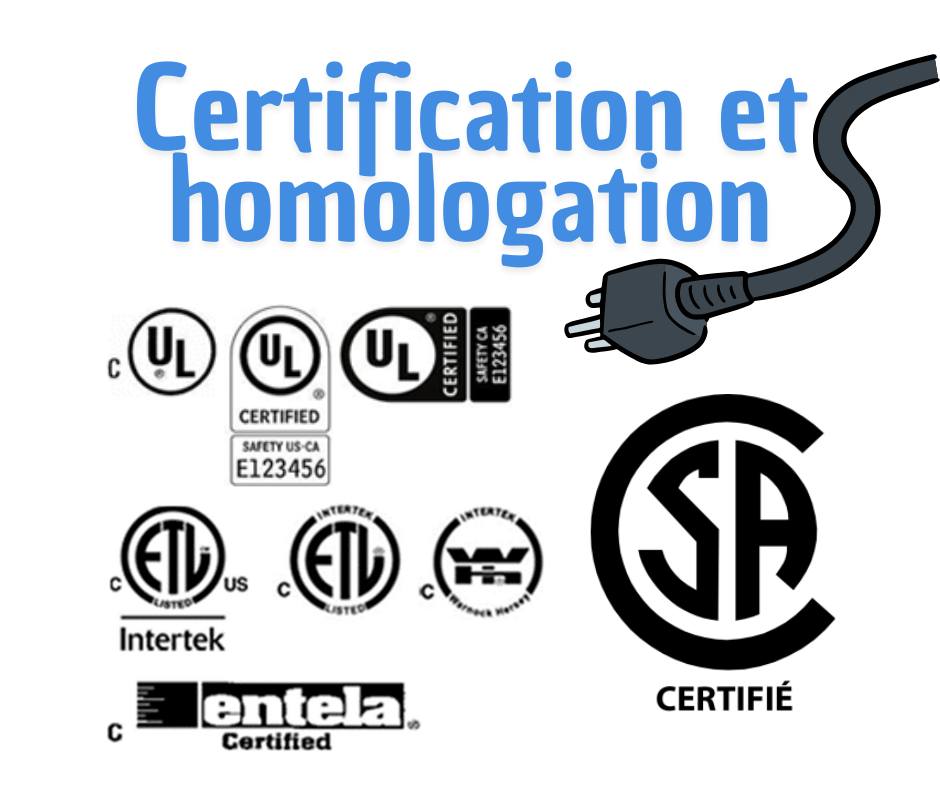
Recognizing an approved product is simpler than you might think, as long as you know where to look. The seal of approval must be visible directly on the product itself or on its packaging. It consists of the logo of a recognized certification body, and its presence confirms that the product has been evaluated and found to comply with applicable standards.
A practical detail to know: products certified to Canadian standards generally display a “c” indicator on the certification seal, positioned at the bottom left of the logo—at the 8 o’clock position. This small “c” is your visual cue to confirm that the certification is valid for the Canadian market and not just for another territory.
Certification and approval: two words, two realities
These two terms are often used interchangeably in everyday language, but they refer to distinct realities worth understanding.
Certification is an attestation issued by an independent body confirming that a product meets specific technical standards. It is a voluntary or mandatory process depending on the sector, conducted by a third party that objectively evaluates the product.
Approval (homologation), on the other hand, is an official validation granted by a competent authority—such as a government or regulatory body—confirming that the product complies with current legal and regulatory requirements. It is a form of official recognition that carries the force of law.
In practice, a product can be certified without being approved, and vice versa, depending on the context. In the electrical field in Quebec, certification by an accredited body is the determining criterion for the legal marketing of a product.
The danger of non-certified and counterfeit products
The market is full of low-priced electrical products, often imported, that have never undergone any certification process. These products may appear functional, but they represent a real risk to the safety of people and property. Counterfeit products are even more problematic: they sometimes mimic the appearance of certified products and may even reproduce fake seals of approval.
Caution is therefore necessary, especially when shopping online on international platforms where product traceability is often difficult to establish. An unusually low price for an electrical appliance should always raise suspicion. Safety is not a budget item where you should cut corners.
Where to find official references?
To consult the complete list of bodies that have received approval for electrical equipment, as well as recognized seals and labels, the Régie du bâtiment du Québec (RBQ) is the essential reference. Its website provides all the information needed to validate the legitimacy of a certification body and, by extension, the compliance of a product.
In summary: habits to adopt
- In Quebec, every electrical product sold must be approved or certified by an accredited body—this is a legal obligation, not just a quality criterion.
- Look for the seal of approval directly on the product or its packaging in the form of a recognized body’s logo.
- For products certified to Canadian standards, look for the “c” indicator at the bottom left of the logo (8 o’clock position)—this is your confirmation that the certification is valid in Canada.
- Do not confuse certification (attestation from an independent body) and approval (official validation by a regulatory authority): they are two distinct processes.
- Beware of non-certified products and counterfeits—a fake seal or the absence of a seal can signal a dangerous product.
- An unusually low price for an electrical product is often a sign of non-compliance with Canadian standards.
- To find the list of accredited bodies and their official seals, visit the Régie du bâtiment du Québec (RBQ) website.
A seal is small. But ignoring it can have big consequences.
Sources: Ministère de la sécurité publique du Québec and Régie du Bâtiment du Québec